

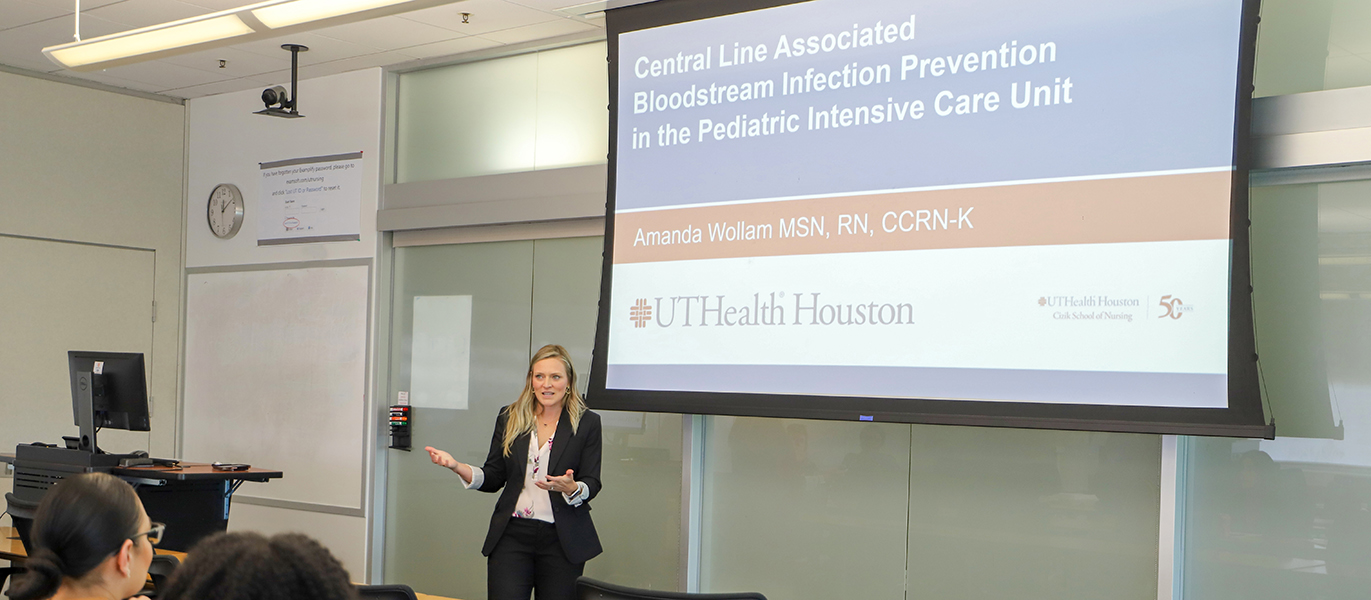
Our Doctor of Nursing Practice (DNP) students can help community partners address real-world health care issues and challenges through their final DNP projects.
A Doctor of Nursing Practice project is the capstone scholarly work completed by students in a DNP program. It’s designed to translate evidence into practice and improve real-world health care outcomes, not to generate new theory like a PhD dissertation. It may include quality improvement initiatives, the implementation of evidence-based practice, program evaluation, or health policy analysis. Key elements must include:
-
- Identification of a problem,
- A search, analysis, and synthesis of the literature and evidence,
- Translation of the evidence to construct a strategy or method to address the identified problem,
- A plan for implementation and sustainability, with actual implementation, when possible,
- An evaluation of the outcomes, processes, and/or experiences, and
- Dissemination of results to stakeholders.
DNP projects usually span four consecutive semesters, starting in the spring or summer. Actual implementation and evaluation may run 10-14 weeks.
Community partner requirements:
-
- Facilitate execution of an educational agreement or contract if one does not currently exist
- Serve as the DNP student’s site liaison and assist the student as a project team member
- Assist the student with the site-based project approval process (such as human subjects protection or institutional review board)
- Provide implementation support at the project site
- Provide feedback to the student and the DNP faculty adviser as needed
Examples of DNP projects
-
- Enhancing Ventilator Bundle Compliance in the CVICU to Reduce Ventilator-Associated Pneumonia
- Implementing Distress Screening Tool Utilization and Referrals Among Inpatient Oncology Patients
- Continuous Glucose Monitors as a Bridge Between Hospital Discharge and PCP Follow-up
- Culturally Centered, Primary Care Interventions for Effective Weight Management Goals in Hispanic/Latino Children
- Implementing Interventions to Decrease Readmission Rates in a Behavioral Hospital for People Experiencing Homelessness
- Implementation of a Protocol for Formerly Unhoused Young Adults Transitioning to Independent Living Discharged on Oral PrEP
Additional examples can be viewed at https://digitalcommons.library.tmc.edu/dnp_abstract/