Geographic reach expands for rural pain management study Four states added to auricular point acupressure trial
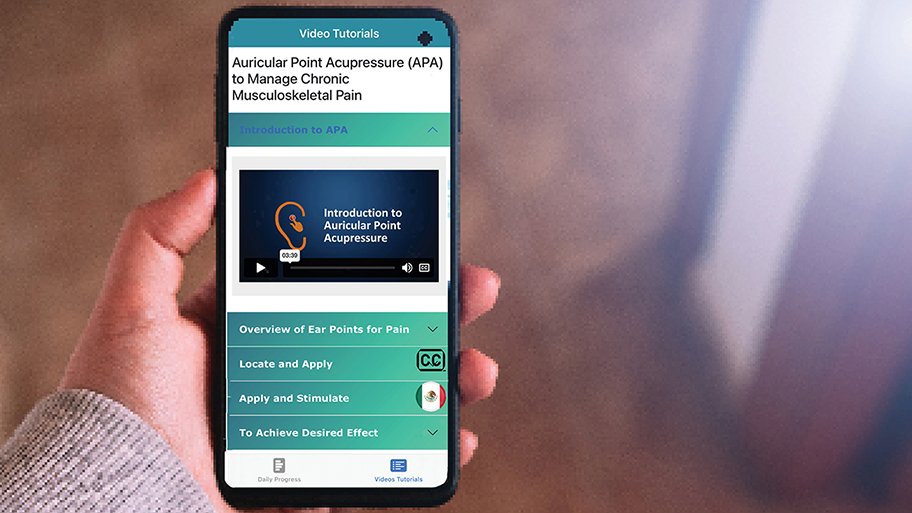
Patients living with musculoskeletal pain in rural areas of Oregon, Washington, Wyoming, and Wisconsin will soon be able to participate in the large-scale trial of a nonpharmacological auricular point acupressure intervention led by Jennifer Kawi, a professor at Cizik School of Nursing at UTHealth Houston.
Her team is working to recruit almost 700 participants, currently in rural parts of Texas and South Carolina. Recent grants from the National Institutes of Health to rural primary care research networks will expand the project’s reach to the additional four states. The study employs a smartphone app and in-person as well as remote coaching to support self-administration and self-monitoring of the intervention, which involves placing small seeds on the ear to stimulate specific points that correspond to body parts in pain.
In June 2024, the NIH launched Communities Advancing REsearch for Health (CARE for HealthTM), an initiative to establish rural research hubs through networks of primary care clinics.
“The goal is to bring clinical trials to practices that serve patients in rural areas, which historically have been underrepresented in research studies,” said Kawi, PhD, MSN, FNP-BC, CNE, FAAN. “These communities need innovative, low-cost, practical interventions for patients who often travel long distances for healthcare.”
The NIH has funded six rural network research hubs that are evaluating and implementing ongoing studies that match the needs of the populations they serve, she explained. Two of the hubs recently received NIH grants to begin offering the auricular point acupressure intervention at several clinics in the Northwest and Wisconsin.
The team based at Cizik School of Nursing will coordinate the project and train community health workers and site coordinators, who will recruit patients served by the rural clinics and teach them how to self-administer auricular point acupressure to assist with pain relief. Participants are randomized into three groups – auricular point acupressure with in-person training, auricular point acupressure with remote training, and a control group receiving pain education and self-management skills.
Potential participants may learn more about the study and eligibility requirements at https://go.uth.edu/pain.
Last year, Kawi received a four-year, $5.98 million award for her project, “Personalized Auricular Point Acupressure for Chronic Pain Self-Management in Rural Populations (UH3AT012728),” from the National Center for Complementary and Integrative Health and the National Institute of Neurological Disorders and Stroke of the NIH. The award is part of the NIH’s Helping to End Addiction Long-term® (HEAL) Initiative.
The two networks added to the study this year through CARE for Health are:
- The Primary Care Rural and Frontier Clinical Trials Innovation Center (PRaCTICe), a collaboration between Oregan Health & Science University’s Oregon Rural Practice-based Research Network (ORPRN) and the University of Washinton School of Medicine’s WWAMI region Practice Research Network. Melinda Davis, PhD, is the director of ORPRN; Sebastian Tong, MD, an associate professor at the University of Washington School of Medicine, will serve as co-investigator of the PRaCTICe grant; and Claire Simon, MD, at University of Washington will be the site lead.
- The Wisconsin Research and Education Network (WREN) at the University of Wisconsin Department of Family Medicine and Community Health. Mary Henningfield, PhD, is the executive director for WREN, and Sarina Schrager, MD, MS, is the medical director.
Co-principal investigators on the auricular point acupressure study are Hulin Wu, PhD, the Betty Wheless Trotter Professor and Chair of the Department of Biostatistics and Data Science at the School of Public Health at UTHealth Houston; and Tonychris Nnaka, PhD, MPH, RN, CPH, FAAN, associate vice president of health research and innovation and an associate professor in the College of Nursing with the University of North Texas Health Science Center.
Kawi is the Maria C. and Christopher J. Pappas Family Distinguished Chair in Nursing and a fellow of the American Academy of Nursing.