Finding the positive for trauma recovery Hamby discusses resilience at 2026 Diaz-Lewis Lecture
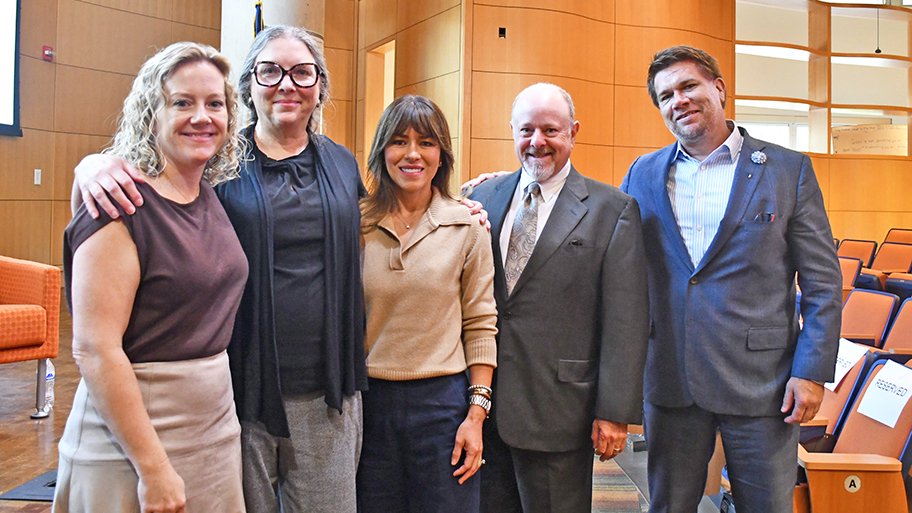
Practically everyone experiences trauma – often multiple times throughout life – and resilience hinges on figuring out how to feel better and find hope for the future, according to Sherry Hamby, PhD.
Hamby delivered the keynote address at the 2027 Carla Diaz-Lewis Domestic Violence Lecture at Cizik School of Nursing at UTHealth Houston. She is a distinguished research professor of psychology at the University of the South in Sewanee, Tenn., director of Life Paths Research Center, and founder and co-chair of ResilienceCon, an international conference on strength-based approaches to addressing trauma and adversity. Her presentation drew from her recently published book, “Stronger Than You Think: Building Lifelong Resilience,” and she autographed copies for attendees during the luncheon reception following the lecture.
Science and society have come a long way since Jackie Gleason’s character in “The Honeymooners” regularly threatened to knock his wife “to the moon,” Hamby said, but much work remains to be done.
She traced three “revolutions” in research, beginning with studies that found trauma to be far more common and harmful than previously known.
“I think this was the most impactful social science that has ever been done on any topic,” Hamby said. These early studies led to advancements such as the Violence Against Women Act, child welfare programs, and funding for domestic violence shelters.
However, much scientific work was siloed within specialties. Hamby marks the Adverse Childhood Experiences Study led by Vincent Felitti, MD, in the 1990s as the beginning of the second revolution in trauma research. His team found that the more instances of trauma a person experiences in childhood, the more likely they are to develop not only depression, PTSD, or substance use disorders, but also cancer and diabetes.
“The link between trauma dosage and later health problems is stronger than it is for things that we often talk to patients about like diet and exercise,” Hamby noted.
The current revolution in trauma science focuses less on the bad things that have happened to people and more on ways to make them feel better, she said.
“You can overcome really substantial doses of trauma,” she said. “There is extensive research showing that the most common result after trauma is resilience.”
Scientists are beginning to spend more time asking people how they triumph over trauma, and Hamby’s newest book focuses on four pillars – “meaning making,” interpersonal relationships, the physical environment, and emotional regulation.
Her team looked at more than 70 psychosocial strengths and found a handful that repeatedly showed significant positive impact. “Meaning making” – or developing a sense of purpose and hope – consistently ranks among the most effective because it encourages people to look positively toward the future.
Hamby also discussed a literature review on secondary trauma undertaken by one of her mentees whose mother was an ICU nurse during COVID. She was struck by the differences in language used in papers about the nurses compared to publications about people characterized as victims of violence. Unlike other populations, the nurses were asked about how they maintained their resilience. Many identified social networks outside of work as a key. Hamby’s team then created a measurement tool focused on social connection, which was quickly revealed to be another of the most impactful factors in resilience.
With regard to physical environment, Hamby boiled down the essence of many nature-based interventions to “Go outside somewhere nice.” “All of these interventions have impacts that are at least as good as cognitive behavioral therapy or psychotropic medications,” she said.
Finally, on the topic of emotional regulation, Hamby advocates for shifting the focus from dissipating negative emotions to cultivating positive ones.
“People are just waiting for you to ask them the story about how they put together the pieces of a good life even after a bunch of bad things happened to them,” she said.
Following the lecture, Hamby fielded questions from Jeffrey Temple, PhD, associate dean for clinical research and the Betty and Rose Pfefferbaum Chair in Child Mass Trauma and Resilience at the UTHealth Houston School of Behavioral Health Sciences and director of the Texas Violence and Injury Prevention Research Center. Among other topics, they discussed applying resilience concepts to violence prevention efforts.
Hamby’s lecture was the latest in the series established in 2021 by long-time Cizik School of Nursing supporter Carla Diaz-Lewis and her husband, Kenneth Lewis. The series aims to teach healthcare providers and community members how to identify and assist victims of domestic violence.
Sherri Deatherage Green