
New grant funds nursing pipeline program Sarofim Foundation grant will expand opportunities for high school students to pursue nursing careers
A career in nursing can help young people skip several rungs on the ladder of economic advancement, and a new grant will give that opportunity to dozens of Houston-area high-school students.
Sarofim Foundation has committed a significant gift to the “High School to Nursing Education Pipeline (HSNEP) Program: Improving Economic Mobility and the Nursing Shortage in Houston,” co-led by Maja Djukic, PhD, RN, the John P. McGovern Distinguished Professor in the School of Nursing and a professor in the Department of Research at Cizik School of Nursing at UTHealth Houston, and D’Hania Miller, MSN, RN, an instructor in the Department of Undergraduate Studies.
“Our overarching goal is twofold. We want to fuel economic mobility for low-income students and, in doing so, help fill some of the 5,000 seats that remain empty in Texas nursing schools each year,” Djukic explained. “Our program will be the first in the nation to produce high-quality evidence demonstrating the potential effectiveness of a nursing pipeline program on improving economic mobility outcomes for disadvantaged youth.”
Texas could face a shortage of more than 57,000 nurses by 2032, Djukic said. HSNEP is creating a quicker, more direct entry into nursing to grow the nursing workforce and, in the process, improve education and employment outcomes for youth from economically disadvantaged backgrounds, she added.
The need to work while learning means lower-income students who want to become nurses often follow a “stacked” pathway. They may start as a certified nursing assistant and progress to be a licensed vocational nurse or an associate degree nurse, and they may eventually earn a Bachelor of Science in Nursing. Unfortunately, many do not progress along this prolonged path or achieve the increased earning potential a BSN brings.
“Members of Gen Z are facing a tough job market as they start their careers, and finding employment that can sustain not only financial but physical well-being is even more difficult for youth from lower-income families,” Djukic said. “However, hands-on nursing will always be needed, and demand continues to grow as our population ages.”
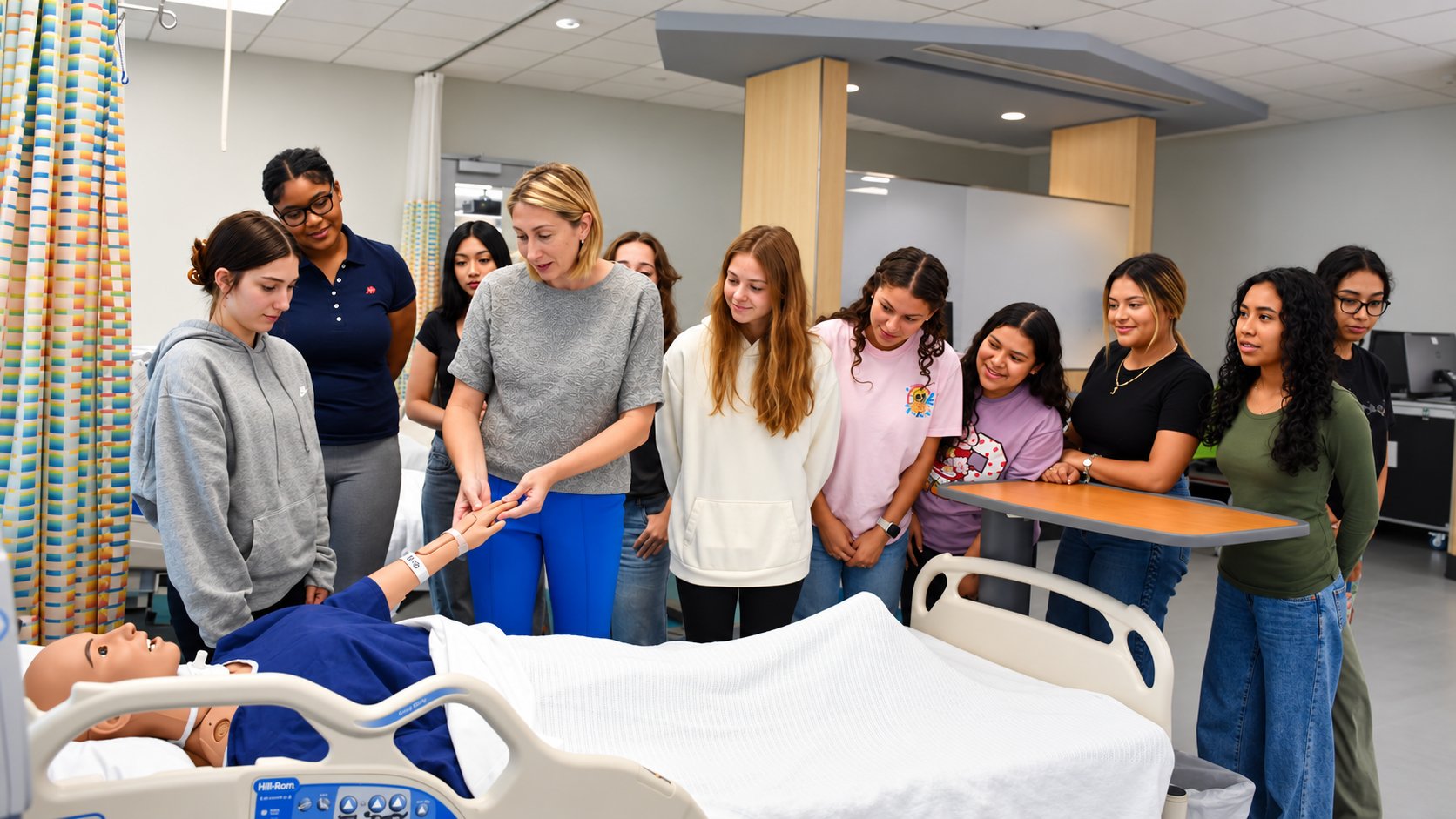
The pipeline at Cizik School of Nursing starts with a summer camp program that Djukic and Miller have built over the past four years with the help of pilot grants from the William Randolph Hearst Foundation and the HCA Foundation. In 2026, more than 140 high schoolers participated in three weeklong camps where they learned from Cizik School of Nursing faculty and practicing nurses while earning up to five healthcare-focused certifications. Participants also received counseling on which dual-credit or advanced placement courses they can take in high school that align with nursing program prerequisites. Students also attended nurse-led enrichment sessions designed to expose them to the variety of nursing specialties, advanced nursing degree programs, and entrepreneurial opportunities a professional nursing career offers.
Cizik School of Nursing implemented two other key elements of the pipeline in the 2025-2026 academic year:
- In the fall 2025 semester, the school admitted the first cohort of students to its Pre-Nursing Pathway, which provides up to 27 hours of nursing-specific prerequisites. The second, larger class will begin its studies in fall 2026.
- The UTHealth Houston Future Nurses Fund provides free tuition and required fees to full-time BSN students at Cizik School of Nursing who are Texas residents and earn less than $100,000 in annual adjusted gross income. When Future Nurses Fund scholarships were first offered in the spring 2026 semester, 111 students benefited.
The grant from Sarofim Foundation will cover the cost of the immersive summer camps and provide a stipend for 300 students over three years from the Houston, Spring, Clear Creek, Alief, and Katy school districts. Of that group, 150 will participate in a year-long mentoring program that includes monthly virtual meetings with practicing nurses. As the program gets started, 25 high-school seniors will receive mentoring in the fall 2026 semester and participate in summer camps next year, Miller said.
Djukic’s goal is for 75 of the students to ultimately enroll in the Pre-Nursing Pathway the fall after they graduate from high school. Those who then complete each required course with a grade of “B” will qualify for direct admission to the Pacesetter Accelerated BSN program and may receive financial support from the Future Nurses Fund or other scholarships.
“The HSNEP program, combined with the Pre-Nursing Pathway and the Future Nurses Fund, will make it possible for students to graduate with a BSN within 2 ½ years of finishing high school,” Miller said.
However, additional financial support is needed to help economically disadvantaged students pay tuition and fees for the two-semester Pre-Nursing Pathway. Although courses such as anatomy, physiology, and microbiology are essential for admission into nursing programs, they are often classified as nondegree or transitional coursework, so students taking them as nursing prerequisites don’t always qualify for government financial aid or institutional scholarships.
“This gap creates a significant access barrier to nursing education for low-income students and contributes to a leaky nursing education pipeline,” Djukic said. “The lack of financial resources could delay their enrollment in the nursing program or cause them to drop out.”
Dean Diane Santa Maria stressed the importance of identifying and developing funding sources to support students as they transition from high school to college while earning nursing prerequisites.
“Cizik School of Nursing is located in the middle of the world’s largest medical center. We give our students not only a top-tier education but the opportunity to step out of our door and into well-paying jobs at world-class healthcare organizations,” said Santa Maria, DrPH, MSN, RN, ACRN, PHNA-BC, the Jane and Robert Distinguished Chair and Huffington Foundation Endowed Chair in Nursing Education Leadership. “This innovative nursing pipeline program also gives our generous supporters the potential to make sure that door of opportunity stays open for promising students.”